The stock came into the period near 4,627 yen. It now sits at 3,701, a decline of roughly 20 percent across three months, with most of the damage concentrated in a single move after the FY2025 results landed on May 12. The intraday low of 3,415 on June 2 came on rising volume against a falling trend. The most recent session ran the other way, up 3.58 percent on heavy turnover, while the reported fundamentals beneath it stay anchored to the year that closed in March. The headline P/E of 32.7x and the 12.49 trillion yen market cap reflect those pre-move financials, not the price you can buy at today.
What killed the price was not a miss. Revenue rose 14.06 percent to 4.974 trillion yen, net income rose 35.32 percent to 332 billion yen, and the result cleared prior guidance. The market sold it anyway, fixating on conservative forward language, uneven segment margins, and translation sensitivity. Logistics, Thermal & Drive Systems showed revenue declines on lower turbocharger and HVAC volume. Technical sell signals followed the fundamental doubt rather than preceding it.
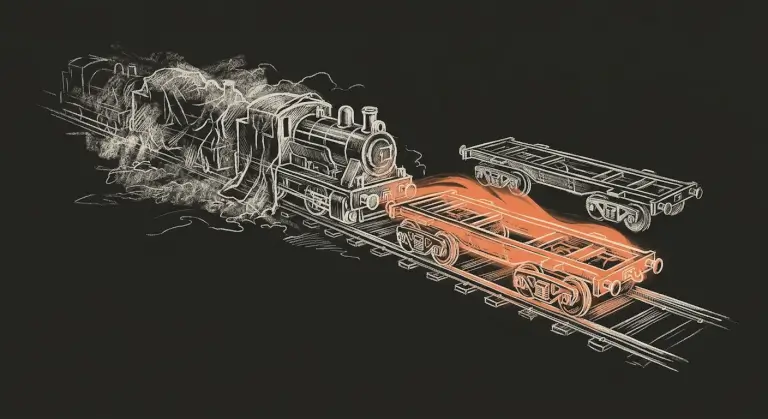
The operative question is whether the order book underneath supports the price the market just assigned, or whether it doesn’t. In machinery, the chain runs backward from the field: inventory and used equipment values lead new orders, aftermarket mix carries margin through soft quarters, and fleet age decides when the replacement cycle turns. MHI’s binding number is the order book, and it moved the right way. Order intake reached 7,653.6 billion yen in FY2025, up 1,248.4 billion yen year over year. Backlog crossed a record 12 trillion yen, having climbed to 12,247.4 billion by the end of the December quarter. Operating margin expanded to 9.54 percent from 8.07 percent, the first signal that the cost base reset during the prior contraction is holding as volume rebuilds. A nine-handle operating margin on a backlog of that size is the margin floor doing its job. The aftermarket catalogue across gas turbines and defense systems is what carries that floor when any single segment, turbochargers in this case, destocks.
Heavy industrial names that sell off after a clean beat tend to resolve one of two ways, and the divider is the order book, not the chart. When the decline is digestion of a conservative outlook against a rising backlog, the price gap closes as execution catches up to the orders already booked. When the decline marks the front edge of a demand rollover, the backlog stalls first and the margin follows it down a quarter or two later. The setup here matches the first pattern: orders up, backlog at a record, margin expanding. That is the structural signature of repricing sentiment, not deteriorating mechanics.
The demand environment reinforces the booked orders rather than substituting for them. Japan’s FY2026 defense budget exceeds 9 trillion yen, up around 9 percent, and the eased export principles open the Aircraft, Defense & Space segment to programs that were previously domestic-only, including the GCAP fighter and frigate exports. The 7th Basic Energy Plan’s pivot to maximize nuclear generation toward roughly 20 percent of the mix by 2040 feeds Energy Systems through reactor restart and equipment demand. Both are multi-year procurement cycles, the kind that convert to backlog slowly and execute slowly. Neither was the reason the stock fell.
One structural feature of the reported number deserves naming. The long-cycle contract base means raw material cost moves and currency translation hit revenue and reported margin on a lag relative to when the order was struck, so a single quarter’s OPM can flatter or understate the through-cycle picture depending on which contracts are recognizing. The 9.54 percent figure should be read as a point on a long contract curve, not a clean read of current unit economics.
The counter sits inside the same data. Order intake is a leading indicator only until it stalls, and the export-control friction flagged around the Defense & Space outlook is the one variable that can convert backlog into deferred or cancelled deliveries without the headline order number ever turning down. A record book of 12 trillion yen is worth what executes, and a heavy industrial backlog can hold its nominal level while delivery slippage quietly erodes the margin the market is now pricing. The turbocharger and HVAC softness in Logistics, Thermal & Drive is the visible edge of that risk, a segment already destocking while the consolidated number still expands.
Valuation is where the two readings diverge sharply. The consensus average target sits at 5,366.83 against the current 3,701, with a low of 2,810 and a high of 6,400. That spread is unusually wide for a name this size, and it is the analyst community pricing the same fork: either the backlog executes near the recorded margin and the multiple normalizes through earnings, or the EV/EBITDA on through-cycle margin is being set against a backlog that delivers light. At 32.7x trailing earnings the price is not cheap on reported numbers, but the backlog implies a forward earnings base the trailing figure does not yet reflect.
If order intake declines year over year in the next reporting cycle, or backlog slips below 12 trillion yen, the digestion reading is wrong and the decline is structural. Until one of those prints, the order book is the body on the table, and it shows orders up, backlog at a record, and margin expanding into a demand environment that has not yet finished converting to bookings.
Whether the 12 trillion yen executes near a nine-handle margin, or slips into delivery deferral the order line never shows, is the question the next backlog print answers.
Revenue: ¥4974.2B · Net Income: ¥332.1B
EPS (trailing): ¥98.90 · EPS (forward est.): ¥113.10
P/E: 32.7x · P/B: 4.03x
Shares Outstanding: 3.36B
Tax Rate: 30% (statutory) · DPS: ¥25.00 · Yield: 0.78%
Analyst Target: ¥5366.83
Source: kabutan.jp, Yahoo Finance · Price as of today
Figures reflect the most recent available data and may differ slightly from live market prices. · © Mathstock