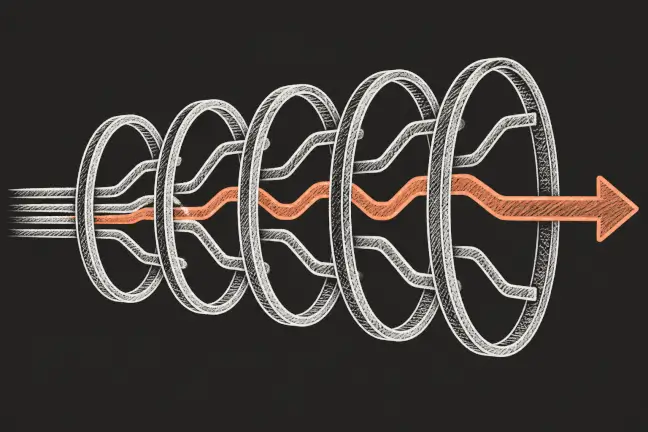
Revenue up 70.7%, earnings up 107.9%. When the bottom line grows half again as fast as the top line, you are not looking at a steady-state business. You are looking at operating leverage running in one direction, and operating leverage running that hard is a cycle signature, not a personality trait. The relevant question is not whether NVIDIA designs the best accelerators. It plainly does. The question is where on the supply-demand curve those margins were minted, and what the curve does next.
Start with the number that locates everything else: 74.9% GAAP gross margin in the most recent quarter, sitting in a 73% to 75% band across the last several prints. Margins like that are what a semiconductor business earns when demand is running ahead of supply and the customer cannot get enough parts to push back on price. Data Center is now roughly 92% of revenue, $75.2 billion out of $81.6 billion, which means the entire margin structure is a single end-market’s pricing power expressed through one constrained input: advanced packaging. NVIDIA has historically held more than 70% of TSMC’s CoWoS capacity and roughly 63% of total CoWoS demand. That is the physical machinery of the current peak. The pricing holds because the foundry’s packaging lines, not the design, are the binding constraint. Utilization is pinned, lead times are long, and that is exactly the configuration that produces a 75% gross margin.
We have seen this configuration before, and not only in silicon. Every supply-constrained cycle prints the same chart: a scarce input, a customer base bidding for allocation, gross margins that climb past what the long-run replacement cost of capacity would justify, and a price chart that mistakes scarcity for permanence. Memory did it through the HBM bit-growth scramble. Foundry did it when leading-edge wafer starts could not keep pace with a node transition. The mechanism repeats because capacity is lumpy and lead-bound. A new CoWoS line, a new fab shell, a new lithography step does not arrive on the quarter it is needed. It arrives eighteen to twenty-four months later, in a batch, often alongside everyone else’s batch. The margins that look structural at the top are the margins that supply has not yet had time to compete away.
The stock has run with the cycle. Shares moved from around 183 to 219 over three months, an 11% gain in the last month alone, with the May quarter’s record print, an $80 billion buyback authorization, and the Blackwell-to-Rubin cadence doing the work. The market is repricing growth durability, and that single variable, whether hyper-growth holds or rolls over, is what every multiple on this name now hinges on. A mid-cycle multiple looks one way against trailing earnings and an entirely different way against normalized earnings power. The peak-to-trough EPS range in this industry is wide. Buyers paying today’s price are paying it on the assumption that the current quarter is closer to the middle of the curve than the top of it.
The backdrop tightens the read rather than loosening it. U.S. export-control guidance has now moved to close the subsidiary-routing loopholes that let advanced parts reach Chinese buyers, with top-tier Blackwell exports under de facto ban, so the demand pool that mattered most for the next leg of allocation is being administratively shrunk. Europe is pushing its own Chips Act revision and an AI rulebook reaching full force in August, both designed to seed local capacity and reduce dependence on U.S. silicon. Capex intensity across hyperscalers is still climbing, which is the fuel under the current utilization. But the same easy-money conditions and AI-build enthusiasm that pulled forward orders are precisely what tends to overshoot, because every buyer orders for the demand they fear they cannot meet, not the demand they have. That double-ordering is invisible until it isn’t.
On the supply side, the thing to watch is not NVIDIA’s backlog. It is inventory days at the customer. Backlog tells you what was ordered in a panic; customer inventory tells you what is actually being consumed. The chain from here is mechanical: CoWoS capacity expands, allocation loosens, the customer who was double-ordering to secure parts stops, inventory days at the hyperscalers and OEMs climb, and pricing power leaks before reported gross margin gives any warning. Utilization peaks first, pricing rolls second, margin follows third, and capex discipline arrives last and reluctantly, usually after the new lines have already taped out and started to depreciate. That sequence is the whole cycle in four moves.
The counter is structural. For this not to resolve as a cycle, the binding constraint would have to stay binding through the next capacity wave. CoWoS additions would need to be absorbed as fast as they come online, which requires AI inference workloads to scale into a genuine new floor of recurring compute demand rather than a one-time training build. If accelerated computing becomes the depreciating base layer of every data center, replaced on a hardware refresh cadence the way servers always have been, then the demand curve has a regulatory-grade floor under it and the usual oversupply correction gets compressed into a shallow dip. The Rubin cadence is the test of that thesis. If each platform transition resets the constraint before the prior node’s supply catches up, the cycle stretches rather than breaks. That is a real mechanism. It is also exactly the argument made at every prior peak, by buyers who could not picture the line that was already being poured.
If Data Center gross margin holds in the 73% to 75% band for the next four quarters while CoWoS capacity expands materially, the supply-constrained read is wrong and demand is genuinely outrunning the capacity wave. Until I see that, I am reading 75% as a peak-cycle margin, not a resting one. The earnings are real. So was the demand at the top of every cycle that mattered.
Revenue: $253.5B · Net Income: $159.6B
EPS (trailing): $6.53 · EPS (forward est.): $9.75
P/E: 33.5x · Forward P/E: 22.0x
Shares Outstanding: 24.22B · Beta: 2.20
Tax Rate: 21% (statutory) / 15.8% (effective) · DPS: $1.00 · Yield: 0.46%
Analyst Target: $298.07 · Rating: Strong Buy
Source: stockanalysis.com, Yahoo Finance · Price as of today
Figures reflect the most recent available data and may differ slightly from live market prices. · © Mathstock